October 4, 2022 in Last Word
FutureBAProf: Demystifying Academic Careers in Business Analytics Departments
SHARE: PRINT ARTICLE: https://doi.org/10.1287/orms.2022.05.14
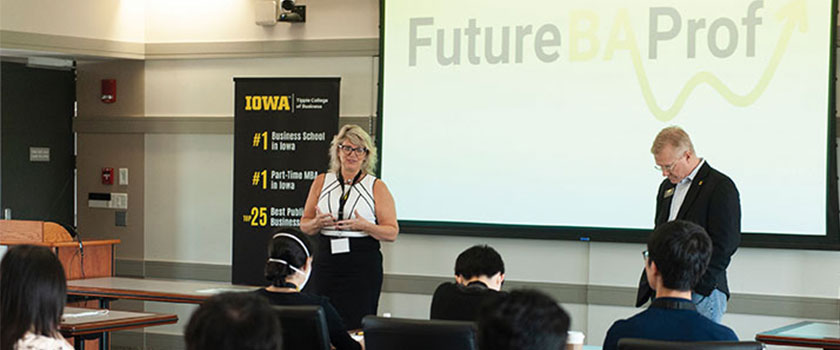
Business analytics is one of the fastest-growing fields in higher education. At the University of Iowa’s Tippie College of Business, the program is one of the largest undergraduate majors on campus, and its seven-year-old master’s degree offering has exceeded all enrollment expectations.
However, even though business analytics is about using analytics in a business environment, finding business school faculty is a challenge because the field is innately multidisciplinary. Faculty come from fields as diverse as computer science, statistics, mathematics and optimization, as well as business. A great application pool has applicants from all of these departments, but many of those professionals do not know that applying to a business school is an option.
The field is also in need of diversifying in terms of race, ethnicity and gender. How does a department of business analytics get people interested in the field, especially those from underrepresented groups? As a professor and department executive officer of business analytics at Tippie, Ann Campbell had an idea.
Inspired by NextProf, a program designed to diversify faculty positions in engineering started by the University of Michigan, Campbell came up with the idea for FutureBAProf, a workshop for Ph.D. students and postdocs to demystify academic careers in business analytics. It was particularly aimed at those from underrepresented groups and designed to diversify application pools at all business analytics departments, not just University of Iowa.
Originally planned for 2020, FutureBAProf was postponed due to COVID-19 until Aug. 15-16, 2022, at the University of Iowa campus in Iowa City. More than 50 people from 33 different universities applied for the workshop and 22 were selected, including a mix of Ph.D. students and postdocs from 21 different schools. More than half of the attendees were women, and five different kinds of academic departments were represented. Participants’ airfare, hotel and meals were covered, so cost was not an attendance barrier for any participant.
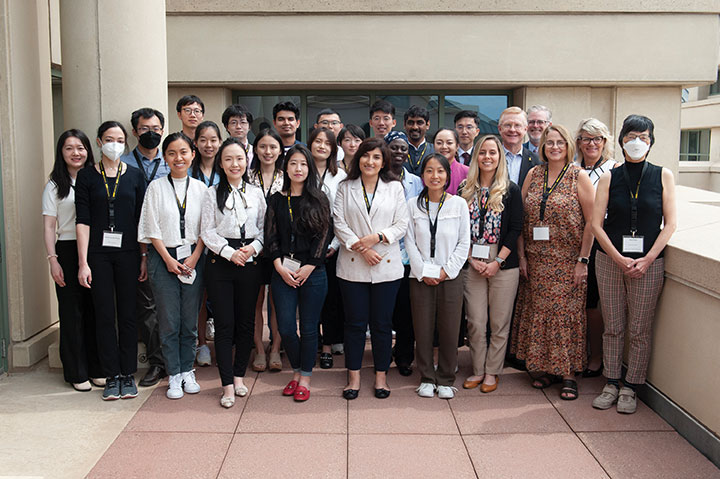
Highlights of the Workshop
- Barry Thomas, senior associate dean at Tippie and a member of the business analytics faculty, led a high-level discussion about the difference between business analytics and other disciplines, delving into topics such as journal lists and grant funding. Many participants found the journal list discussion particularly informative because most are only familiar with the ongoings at their own school/department.
- Participants also learned about journals from several perspectives, including authors, reviewers and editors, thanks to professors Olivia Sheng of the University of Utah, Annabelle Feng of Purdue University and Sam Burer from Tippie. Feng presented interesting tips on how a paper can be written to make it easier for the reviewers to review, and Burer talked about sharing drafts of publications with peers to get feedback before journal submission. Sheng discussed the review process from an editor’s perspective.
- Tallys Yunes, associate professor at the University of Miami, presented a detailed description of teaching at a business school, covering teaching working professionals, using multiple formats and lengths, and case-based teaching. He also provided great tips on what goes into a job applicant’s teaching statement.
- One experience that the participants found educational but quite challenging was presenting a three-minute elevator pitch. They were told two weeks before the workshop to prepare a short presentation of their dissertation. Participants were divided into groups and, at different times on the first day, presented their pitch to the audience. The workshop covered the importance of such short research presentations, which are often the first question that interviewers ask in an interview. With this experience, the participants were able to see the difficulty in this and how important it is to practice their pitch. They also received several tips, such as the amount of content to include in three minutes and how to end the presentation.
- Campbell and Kang Zhao, a professor at Tippie, covered the job hunt process from how to find job ads to first interviews to on-campus interviews, including the job talk, and typical timelines. They also covered contract negotiations and addressed audience questions about visa applications.
The workshop also included a field trip to a local winery and distillery so attendees could further bond and ask questions of faculty in attendance in a relaxed environment.
Based on feedback, attendees particularly appreciated the interactive nature of FutureBAProf – the interactive sessions gave plenty of time for questions throughout and weren’t lectures. Participants also confirmed that there were many things they didn’t know about business analytics departments, even those who came from business-related departments. They also commented on how nice it was to see the friendly relationships among Tippie’s Department of Business Analytics faculty members and discovered the importance of asking how department staff get along during their job interviews.
As any good analytics department should do, the organizers did a pre- and post-workshop survey to get data about the attendees’ perspectives and to see how they changed (Tables 1 and 2).
Table 1. How interested are you in a job in analytics?
|
|
Very interested |
Interested |
|
Pre-workshop |
83% |
17% |
|
Post-workshop |
90% |
10% |
Table 2. Estimate of your knowledge about careers in business analytics.
|
|
Not knowledgeable |
Somewhat knowledgeable |
Knowledgeable |
Very knowledgeable |
|
Pre-workshop |
6% |
67% |
28% |
0% |
|
Post-workshop |
0% |
10% |
52% |
38% |
Here are a few quotes from the postworkshop surveys about what participants found most valuable:
“Many things! A big one was to really understand the possibility of becoming part of a BA program when having a different background. Also, understanding the expectations from the department, demystifying some of the beliefs about business schools and highlighting the differences with engineering schools. This was [a] one of a kind workshop!”
“I really appreciated the talk by Tallys about teaching in business school, which gave us a lot of useful suggestions for teaching.”
“[The workshop] helped me affirm many things that my advisors told me before. For instance, a good department will want you to succeed and will be supportive.”
“What is business analytics, the journal list, some typical expectations and practices, the helpful feedback on the elevator pitches.”
The attendees built such strong relationships during the two days that they organized ways for the entire group to stay in touch, as well as individuals sharing information.
The first FutureBAProf was a huge success, and the Department of Business Analytics plans to host it again in 2023. Lessons learned for future and advice for other schools who may want to run a similar workshop:
- Having most schools represented by only one participant encouraged everyone to form new relationships, which many found quite valuable.
- Simply sharing the reality of faculty experience and being open to questions is very valuable to those who are coming from other departments and disciplines.
- It’s all about jobs. Everyone focused on the job hunt, and organizers could have covered even more about this.
- Based on feedback, one change would be to cover more detail about research fields within the area of business analytics so participants can understand the “typical” areas represented.
It was a wonderful experience for all involved, and organizers hope it encourages the attendees (and those they tell about the event) to consider business analytics departments as part of their job hunt process.
Ann Melissa Campbell is department executive officer and Clement T. and Sylvia H. Hanson Family Chair in the Department of Business Analytics at the University of Iowa. Tong Wang is an assistant professor in the Department of Business Analytics in the Tippie College of Business at the University of Iowa.